Risks exist in all business opportunities. Certain opportunities carry more risks than others. Organisations would like to have resources to handle all the opportunities, but they also know that they have ‘limited resources, at least at that point of time. This is more realistic and reinforces the view that no one has unlimited resources.
Generally the Risks and Rewards are directly proportional to each other. When there are multiple opportunities on hand, the business needs to evaluate the opportunities against the known, and possibly the unknown risks, along with other parameters like ROI. Unlike the other parameters, the risk evaluation may be more qualitative and based on available information. The information used for evaluation should be as accurate as possible and not manipulated by any interested parties, at least such information is isolated during evaluation.
In general, many organisations consider the prospects as ‘positives’ and the risks as ‘negatives’. But some of the prospects could be negative and some of the risks could be positive. If the organisation spends more and more sales efforts for a prospect, whose probability to win reduces over the sales life cycle, is a clear ‘negative opportunity’. Such prospect would certainly drain the company resources and would be demotivating the staff.
Positive Risks are those which are generally understood and acknowledged by the client and planned properly for implementation. Such planning and preparation would help in eliminating or minimising additional cost of delivery.
Many people in the organisation talk about prospects positively before the approval of the project. They are very optimistic and they encourage the whole organisation to support the prospect and they tend to underplay the discussions on risks, before the work is started. However, once the work is started and challenges keep bombarding the project, people talk negatively and discuss more elaborately about the risks that could drive the project towards failure. In many cases, the same set of people talk differently at different times, resulting in frustration for the staff.
If organisations could develop a strategy to bring the aspects of the opportunity and the attributes of potential risks surrounding the opportunity in one place, that would be the first step in the evaluation of the prospects based on risks. Some of the examples of the attributes of opportunity are :
- Current scope and size of the opportunity
- potential future expansion possibilities and size
- ability of the users to adopt the new technology and/or products
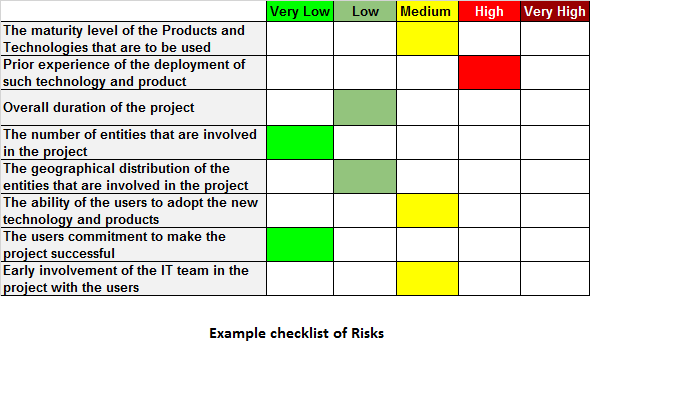
Similarly the example for the risk aspects are :
- The maturity level of the products and technologies that are to be used
- Overall duration of the implementation
- The number of entities involved in the implementation
The next step would be to assign a score for these attributes of the opportunity and risk for each prospect. By assigning a proper weightage for these attributes, the score is comparable across prospects, which could guide the selection of prospects based on Risks.
This process, when followed consistently and systematically, would become part of continuous improvement plan.
For more information kindly contact rv@bizintek.com.my


Leave a comment